

This blog is part of a series dedicated to the future of data-driven marketing. To learn more about QuickFrame’s approach in the new data privacy ecosystem, and to schedule a call with us, check out our Platform Overview.
If you’ve done a cursory Google search for solutions to targeting and data deprecation spurred by Apple iOS updates and Google’s sunsetting of the third-party cookie, you’ve probably seen one popular buzzword: Contextual Advertising. This refers to creating ads that target a broader audience based on the context of where the creative assets run, like related websites or video content.
Contextual Advertising isn’t a new idea by any means, but it can be a unique, privacy-friendly solution to mitigating the effects of Apple’s iOS updates and Google’s deprecation of third-party cookies. They allow brands to naturally reach consumers who may be interested in their products at the moment they are consuming content related to their brand.
Read on to give a full overview of what Contextual Advertising is and the changes that are accelerating the revival of this age-old advertising trend.
- What’s Changing?
- What is Contextual Advertising?
- Why Contextual Advertising?
- Starting a Contextual Advertising Campaign
- Creating Contextual Video Advertising That Converts
What’s Changing?
Tech is constantly changing — it’s a simple fact. The reasons, however, are as nuanced as the code that supports tech’s function. Luckily, the tech industry is on top of its game when it comes to its ability to adapt to change.
So when states began defining how our personal data is collected and shared, the tech industry adjusted to ensure that it could still generate considerable revenue by advertising to consumers.
Have you ever had a text conversation about a pair of shoes, a vacation you’d like to take, or a present you’re considering for a loved one’s birthday — only to find within days, or perhaps even hours, advertisements of the exact product or something like it began to appear on your social media feed, in paragraph breaks while reading the news, or topped the page of your Amazon account?
When big tech offered you its apps for free, it made you a product, and they have been making a killing selling your data — data you agreed they could have — to advertisers who seek to reach audiences with the most precise targeting possible.
This is not a particularly novel concept. The very invention of advertising came out of the need to reach consumers in order to sell products and generate revenue. The method, however, has changed many times — including now.
Learn More: Social Media Video Ad Specs & Placements Guide
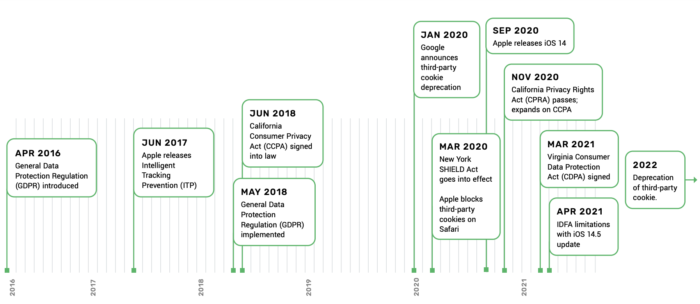
Emerging Data Privacy Laws
With data privacy laws popping up in multiple states and all over the world, online advertisers are adapting in many different ways to keep their eyes on their customers. States like California and Virginia were the first in the U.S. to give users more control over their data. Though the U.S. has yet to pass a comprehensive federal bill, several states are following suit with their own regulations. These regulations have made waves since they began in 2018 and are poised to continue in 2021 and beyond.
So — how is the world of tech and advertising adapting? The answer is simple: contextual advertising.
FREE DOWNLOAD: Go in-depth with the changing landscape of the Data Privacy in our Marketers Handbook!
What is Contextual Advertising?
Contextual targeting for advertising has been around since before the internet even existed and was widely used. You experienced it when you watched television in the 90s, read a certain magazine, or slogged through multiple trailers on a new VHS tape before you could watch your movie. But this isn’t your childhood version of contextual advertising.
Instead of reading data about the individual consumer and assuming what they want to see based on the data, contextual advertising makes decisions based on what potential buyers are already consuming. It matches the content of the advertisement with the content of the webpage. Whether it be video advertising, display ads, or any other type of online marketing, contextual advertising seeks to directly reach the current mindset of the consumer at the moment they are consuming content.
Why Contextual Advertising?
Contextual advertising has multiple unique benefits and is the answer to mitigating the effect of advertisers being weaned from data cookies.
According to Forbes, we scroll a staggering 90 meters of webpage space per day. In that space, only four out of every one-hundred ads is clicked on by consumers. This shows businesses that their ads must be relevant to the potential buyers that are scrolling by them.
For years, advertisers relied on data-generated cookies to personalize ads for consumers. However, using data cookies is not a perfect system.
An advertiser’s information on a consumer generates assumptions about the consumer — but they may not necessarily be true. Additionally, it cannot predict if the consumer will be in the right mindset to see the specific ad that they are placing in front of them. Contextual advertising matches the advertised product with the consumer’s mindset. This happens because the product being advertised at the time is directly related to what the consumer is interested in at that exact moment.
In the digital age of the twenty first century, contextual advertising is set to go through a new transformation. Brands are expecting higher quality, cinematic-level ads that embrace popular social media video trends. Advertisers will not only need to embrace higher quality, creative, and socially trendy advertising, but they’ll also need to be hyper-vigilant to create advertisements with context in mind.
Starting a Contextual Advertising Campaign
Know Your Ideal Shopper
The first step in developing a successful contextual marketing campaign wil be to build your buyer persona and map out their online journey. You likely already know who your customers are but you’ll need to go the extra step and define what media they typically consume. Take the time to learn your consumers’ pain points, find out where they may look to solve those problems, and gather that information on websites that your customers visit and are related to what you offer. This is very important in developing proper context to focus your advertising in the most effective way possible.
Research Topics and Keywords
Another key aspect of contextual advertising is researching search topics and keywords. Once you have a list of websites that your customers visit, you’ll need to figure out a way to get your ads on that website. Incorporating well-researched focus keywords in your contextual advertising campaign increases your opportunities for getting in front of your customers and keeping your brand on their minds.
Make Targeted Ads
Create ads that directly appeal to your consumer. This may seem like a no-brainer, but in this new age of advertising it’s all the more important to hyper-focus your advertising on your consumers personalities, daily journeys through the web, and focus keywords. Contextual advertising that is driven by smart research and made to be as relevant as possible will be the most successful in this future of advertising.
STREAMING IS THE AD WORLD’S NEW NORMAL: Download our free guide The A to Z of CTV & OTT
Creating Contextual Video Advertising That Converts
Contextual Advertising can be a potent, organic approach to reaching customers in a less creepy and intrusive manner than behavioral advertising. But despite the power Contextual Advertising holds in serving ads to relevant consumers, it pales in comparison to the nuanced insights on what is resonating with your audience that can be surfaced through Creative Analytics.

Simply put, Creative Analytics makes Contextual Advertising perform better for brands. Layering on AI-powered insights allows you to dive deeper into what creative generates the most engagement in each context you would like to target. Before Creative Analytics, you couldn’t refine broad Contextual Advertising creative. You had to make it as general as possible from square one–like running a sports-drink ad on a fitness-related website. Now, you can get detailed insights into the type of talent, environment, or product that will perform best on those pages.
Once you’ve learned about your consumer’s journey and where to find them, you’ll need to create high quality content that will grab their attention and uniquely appeal to them. QuickFrame connects brands of all sizes with expert video content makers.
QuickFrame emphasizes data-driven creativity in contextual advertisements. With a marketplace approach to video production, companies are equipped with on-brand, on-point videos for every objective, platform, and style in half the time — and at half the cost of video production compared to traditional approaches. Contact QuickFrame for unique and directly targeted video advertising for your brand today.
THE FUTURE OF RETAIL IS ECOMM: The Ultimate Creative Guide to eCommerce Video